
Video ~ NewsHour @3pm 10-4 April 13, 2026 12:22am

 Video ~ Tinubu Mute 48hrs After Boko Haram Shows Off 416 Women, Children Hostages April 12, 2026 10:21pm
Banking and Media Consultancy… We Analyze The News
Video ~ Tinubu Mute 48hrs After Boko Haram Shows Off 416 Women, Children Hostages April 12, 2026 10:21pm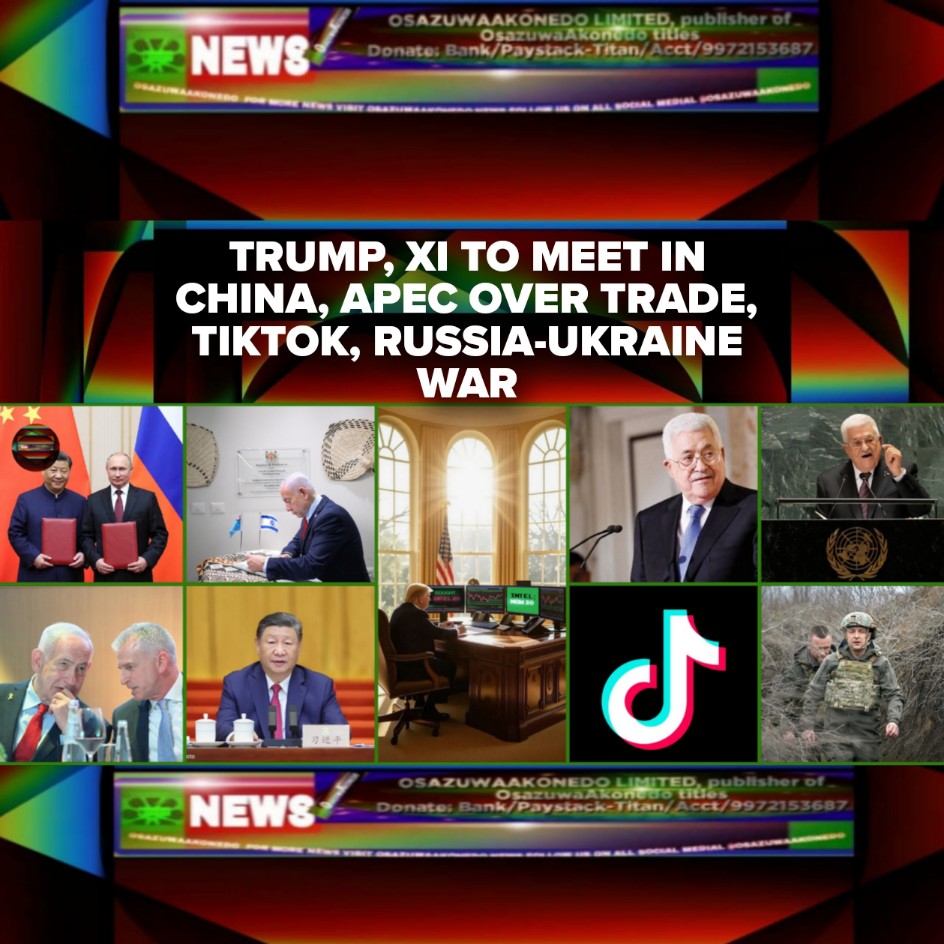
President Donald Trump of the United States, US has announced plans to meet one-on-one with the President of China, Xi Jinping at Asia-Pacific Economic Cooperation, APEC meeting coming this November in South Korea, and according to President Trump, he had a phone call with President Xi to also pay a state visit to China early next year to discuss and find a possible solution to end Russia-Ukraine war, and the US issue with the Chinese owned social networking company, TikTok that may face complete ban in the United States if agreement is not reached on December 16, 2025, that aside, the United States government is currently being considered as a pseudo practitioner of free trade and free speech, and freedom of Association, some observers accused US government of monopoly in the technology industry, that it wants to remain superior in the social networking business hence the US government is demanding to own and control TikTok, trying to use all manners of manipulative and deceptive ways to force ByteDance to sell TikTok to Oracle and Silver Lake among others because of China government alleged control of TikTok algorithm and also allegedly having access to the data of US users, interesting as it maybe, in the aspect of trying to apparently abuse freedom of Association, United States Government under President Donald Trump has revoked and denied visa to Palestinian President, Mahmoud Abbas and 80 other Palestinian authorities inorder for them probably not been able to attend the United Nations General Assembly meeting to speak out their minds against Israel war in Gaza and other Palestinian territory, but, other World leaders on Friday in a vote of 145 against 5 permitted the Palestinian President, Mahmoud Abbas to address the world assembly via Video call next week.
China as one of the biggest economies in the world has been on loggerhead with its major trade rival, the United States since 2018 during the first tenure of President Donald Trump and its loggerhead with US has probably made China to maintain a strategic, pro-Russian position on the war in Ukraine, publicly claiming neutrality while allegedly providing essential economic and diplomatic support to Moscow.
Reports indicated that Chinese officials privately admit that a Russian defeat would not serve Beijing’s interests, which center on its geopolitical rivalry with the United States.
Also, China’s state-controlled media; Xinhua News Agency, People’s Daily, China Central Television which include China Global Television, China National Radio CNR and China Radio International CRI, some of them always using the prominent social networking platform in China, the Weibo social media, are frequently and apparently always amplifying Russian talking points, such as blaming and accusing the North Atlantic Treaty Organisation, NATO of expansionist agenda and the US for allegedly creating the conflict between Russia and Ukraine.
On TikTok, as of September 2025, TikTok continues to operate in the US while its owner, ByteDance, negotiates a deal with American buyers to avoid a ban. The social networking app which has since become one of the most used social media platforms in the world due to its favourable algorithm that challenged older existing social media platforms for low distribution of users contents, was temporarily inaccessible in January 2025 following a Supreme Court ruling but was restored after President Donald Trump delayed the ban.
A key deadline is set for December 16, 2025, for a sale to be finalized. According to a close watcher, “TikTok’s US operations be severed from Chinese ownership, the Per Curium opinion positioned the case as one of “new technologies with transformative capabilities.” In truth, the case — and the law it was ruling on — represents more than that.
Regardless of how the implementation unfolds, the legal ban on Chinese ownership of social media apps operating in the United States is an inflection point in the US-China tech rivalry with implications that extend beyond national security, data privacy, and the First Amendment. It signals a broader US strategy to counter China’s technological influence across industries like semiconductors, artificial intelligence (AI), electric vehicles, and 5G.”
We learnt that a framework deal has been reached that would give American investors control of 80% of TikTok, with Chinese firms retaining 20% ownership. Proposed buyers include Oracle, which already hosts TikTok’s US data, and private equity firms like Silver Lake.
It would be recalled that In April 2024, the US Congress passed a bipartisan law, signed by then-President Joe Biden, that requires Chinese parent company ByteDance to divest TikTok’s US operations or face a nationwide ban. The law was prompted by national security concerns over potential Chinese government access to American users’ data and its ability to influence the platform’s algorithm.
Wikipedia in the summary of the China-US trade war, indicated that: “An economic conflict between China and the United States has been ongoing since January 2018, when US president Donald Trump began imposing tariffs and other trade barriers on China with the aim of forcing it to make changes to what the US has said are longstanding unfair trade practices and intellectual property theft.
The first Trump administration stated that these practices may contribute to the US–China trade deficit, and that the Chinese government requires the transfer of American technology to China. In response to the trade measures, CCP general secretary, Xi Jinping’s administration accused the Trump administration of engaging in nationalist protectionism and took retaliatory action.
Following the trade war’s escalation through 2019, the two sides reached a tense phase-one agreement in January 2020; however, a temporary collapse in goods trade around the globe during the Covid-19 pandemic together with a short recession diminished the chance of meeting the target, China failed to buy the $200 billion worth of additional imports specified as part of it. By the end of Trump’s first presidency, the trade war was widely characterized by American media outlets as a failure for the United States.
The Biden administration kept the tariffs in place and added additional levies on Chinese goods such as electric vehicles and solar panels. In 2024, the Trump presidential campaign proposed a 60% tariff on Chinese goods.
2025 marked a significant escalation of the conflict under the second Trump administration. A series of increasing tariffs led to the US imposing a 145% tariff on Chinese goods, and China imposing a 125% tariff on American goods in response; these measures are forecast to cause a 0.2% loss of global merchandise trade. Despite this, both countries have excluded certain items from their tariff lists and continue to try and find a resolution to the trade war”.
In a statement through his Truth Social Media network on Friday, President Trump said in quotes that; “I just completed a very productive call with President Xi of China. We made progress on many very important issues including Trade, Fentanyl, the need to bring the War between Russia and Ukraine to an end, and the approval of the TikTok Deal.
“I also agreed with President Xi that we would meet at the APEC Summit in South Korea, that I would go to China in the early part of next year, and that President Xi would, likewise, come to the United States at an appropriate time. The call was a very good one, we will be speaking again by phone, appreciate the TikTok approval, and both look forward to meeting at APEC!”.
On US visa denial to Palestine President, Mahmoud Abbas, it would be recalled that Mahmoud Abbas became the President of Palestine in 2005, and barely two years into his administration, the Hamas started governing the Gaza Strip after the Hamas took over the Palestinian Gaza strip territory from the rival Fatah-ruled Palestinian Authority, P.A on 14 June 2007, until the current Israel war in Gaza that started since October 2023, during which Hamas appeared to have lost control of most of the territory.
The administration of United States President Donald Trump announced in August 2025 it was denying and revoking visas for members of the Palestine Liberation Organization, PLO and the Palestinian Authority, PA before the United Nations General Assembly, UNGA in September.
The announcement was made in a statement released by the US Department of State. According to the statement; “The Trump Administration has been clear: it is in our national security interests to hold the PLO and P.A accountable for not complying with their commitments, and for undermining the prospects for peace”.
The Palestinian government responded and the Abbas’s office called the visa decision “astonishing” and a violation of the 1947 UN Headquarters Agreement, which requires the US to allow access for foreign diplomats.
Reuters International News Agency on Friday reported that “The United Nations General Assembly voted on Friday to allow Palestinian President Mahmoud Abbas to address the annual gathering of world leaders next week via video after the United States said it would not give him a visa to travel to New York.
The resolution received 145 votes in favor and five votes against, while six countries abstained. It also allows Abbas and any other high-level Palestinian officials to take part in UN meetings or conferences via video over the next year if they are prevented from traveling to the United States.
The US said last month that Abbas and about 80 other Palestinians would be affected by its decision to deny and revoke visas from members of the umbrella Palestine Liberation Organization and the West Bank-based Palestinian Authority.
“US opposition to this resolution should come as no surprise,” US diplomat, Jonathan Shrier said before the vote. “The Trump Administration has been clear: we must hold the PLO and Palestinian Authority accountable for not complying with their commitments under the Oslo Accords, some of them very basic, and for undermining the prospects for peace.”
Under a 1947 UN “headquarters agreement,” the US is generally required to allow access for foreign diplomats to the UN in New York. However, Washington has said it can deny visas for security, extremism and foreign policy reasons.
Abbas will also be allowed to appear via video at a summit, opens new tabat the United Nations on Monday – convened by France and Saudi Arabia – that seeks to rally support for a two-state solution. Several countries are expected to formally recognize a Palestinian state at the meeting.
The 193-member General Assembly agreed on Friday – by consensus, without a vote – that Saudi Crown Prince Mohammed bin Salman, the kingdom’s de facto ruler, could appear via video at Monday’s meeting”.

Osazuwa Akonedo is a Nigerian media professional, author, and consultant. His work spans various sectors of communication and literature: Journalism and Media: He is the founder of OsazuwaAkonedo, which focuses on news analysis and commentary. He also provides consultancy services in media and banking. Literature: He is a published playwright and author of Nigerian literature. One of his notable works is the drama titled The End Shall Tell: What Exam Malpractice Can Cause, which addresses educational and social issues in Nigeria. Reporting: He frequently reports on regional news, particularly concerning Edo State and broader Nigerian current affairs. Credit: Google Gemini AI Mode Osazuwa Akonedo is a Nigerian media creator, journalist, and entrepreneur who engages audiences via news reporting, social media content, music, and a mobile application. Professional Background and Company Osazuwa Akonedo is associated with OSAZUWAAKONEDO LIMITED, a company registered in Nigeria that operates in media consultancy and news services The company is headquartered in Benin City, Edo State, Nigeria, and has been active in publishing news in various formats including text, audio, video, and photos Social Media and Online Platforms Osazuwa Akonedo maintains a strong online presence on several platforms: TikTok: Shares news updates and reports, for example, covering police operations in Nigeria YouTube: Operates a channel where he uploads videos on current affairs and news content Twitter/X: Active under the handle @akonedo_osazuwa, posting updates on events and news Facebook: Profiles listing his connection to news and media activities can be found on Facebook Mobile App: Offers a dedicated mobile application for news access through Google Play (Osazuwa Akonedo News App) providing text, video, and photo news formats News Reporting and Content He produces news content covering national and local stories, including criminal activities, government updates, and investigative reports His reporting spans multiple formats, making it accessible to a wide audience through online platforms, mobile apps, and social media Other Contributions In addition to journalism, Osazuwa Akonedo has also ventured into audio releases, such as “Former Justice Minister Abubakar Malami Begs Nigerians For Justice” released on January 25, 2026 He also hosts podcasts documenting significant events, e.g, NDLEA arrests related to historical criminal cases Summary Osazuwa Akonedo is a multifaceted media professional engaged in journalism, social media content creation, music, and technology via his news app. He utilizes platforms like TikTok, YouTube, Twitter/X, Facebook, and mobile applications to disseminate news and reach audiences both locally and internationally Credit: Azure AI


To view our content, please accept ALL cookies or support us with a donation.



16 thoughts on “Trump, Xi To Meet In China, APEC Over Trade, TikTok, Russia-Ukraine War”