





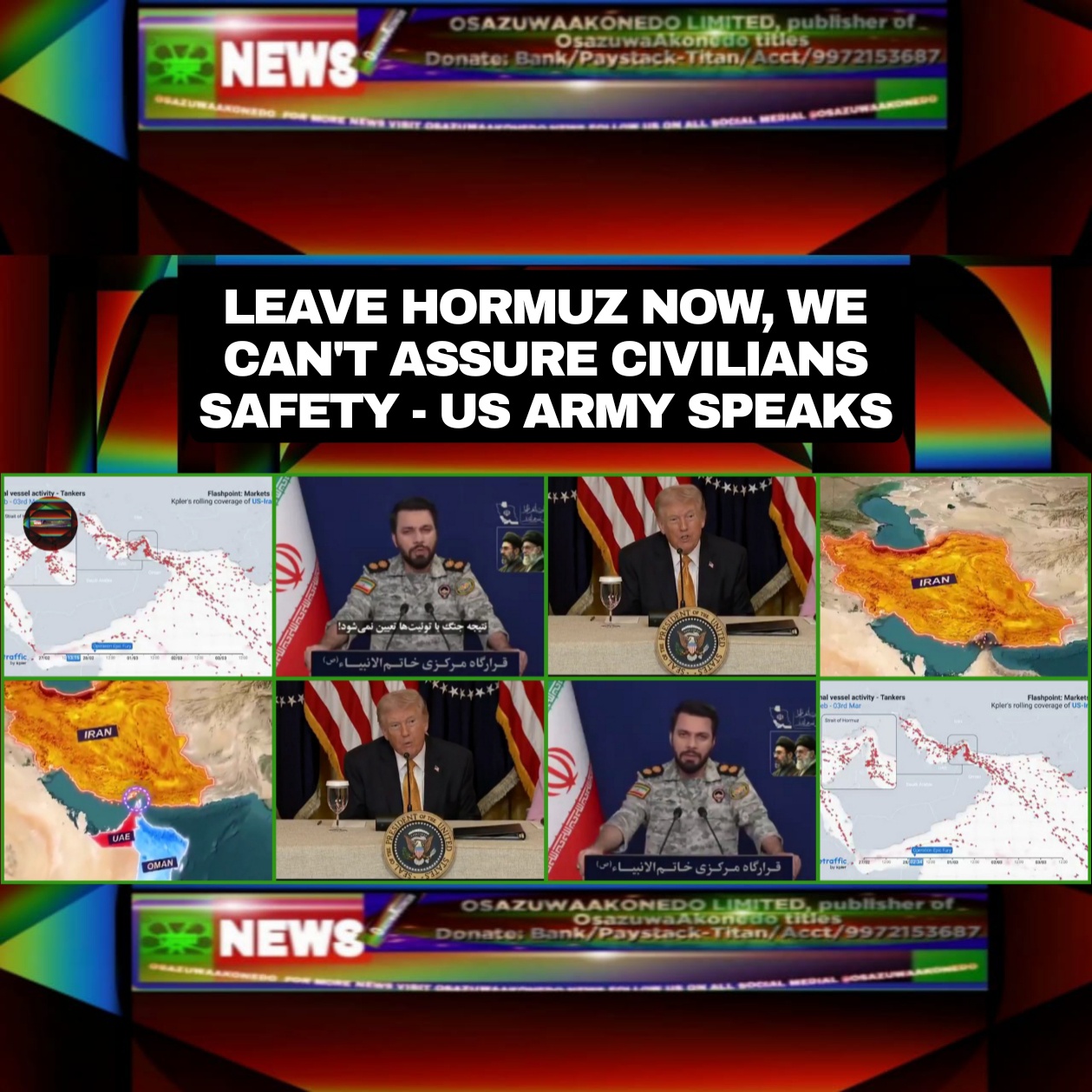
There may be no doubt that Iran is apparently giving the United States, US a tougher time at the Strait of Hormuz, holding strong that none of its enemies and their allies will sail their ship through the strait of hormuz, an action that has since made the US President, Donald Trump to make contradictory statements after the US army obviously failed in its intimidating military campaign and destruction of the Iran Naval base, airport control tower, helicopter hangars, Naval mine storage, missile bunkers and anti aircraft and ballistic missiles defense system, with a threat to destroy the oil lifeline of Iran at the Kharg Island if Iran continued to block ship from sailing through the strait of Hormuz, but yet, as at the time of filing in this report today, Iran remains deviant to US threat, with close watchers saying; Iran may not fight a traditional normal naval war with the US Marines who are currently on a high speed traveling from their base in Japan to the strait of Hormuz, of which, over 2,500 of the US Marines and Sailors have been redeployed and apparently drawn from the 31st Marine Expeditionary Unit, MEU, an elite rapid-response force, and the Marines are traveling aboard an Amphibious Ready Group, ARG led by the assault ship USS Tripoli, LHA-7, an assault ship that can function as a Lightning Carrier, carrying F-35B stealth fighters and MV-22 Osprey transport aircraft and the assigned Marines are expected to arrive the strait of Hormuz in a week or less than two weeks time, but, currently, close watchers said; Iran is using deviant tactics like GPS jamming, swarming drones, and underwater mines to keep the US Navy off balance, an action that may be the reason the US President, Donald Trump initially called on the International communities to help form an international naval coalition to reopen the strait of hormuz but some European countries like Germany, United Kingdom, France, Greece, Italy, and the North Atlantic Treaty Organisation, NaTO refused, with some heads of the European countries saying, “the war is not our war”, “Germany will not participate in any military activity in the strait”, “any plan to reopen the strait won’t be a NaTO mission and that the UK will not be drawn into a wider war”, “no sending France warships to the region until the security situation stabilizes”, “Italy’s current naval missions would not be extended to the strait”, “No Greece military engagement in the waterway”, following this, President Donald Trump in a nationwide media chat on Monday, said; “US don’t need them, we don’t need any body, we are the strongest nation in the world, we have the strongest military by far in the world, we don’t need them, but, it is interesting, in some cases, not because we need them, because I want to find out how they react, we have been protecting these countries for years with NaTO, because NaTo is us, you can ask Putin (Russia President, Vladimir Putin), Putin fears us, he doesn’t fear (them), he has no fear of Europe whatsoever”, meanwhile, Iran strong hold on the strait of Hormuz has made energy prices to go higher; Brent crude has surged to over $105 per barrel, a 40% increase since the start of the war on February 28, 2026, QatarEnergy has declared force majeure on LNG shipments after attacks on its facilities, removing 20% of the global LNG supply from the market overnight, most shipping according to local media has diverted to the Cape of Good Hope, adding 10 to 14 days to journey times and significantly increasing freight costs with Cape Chamber of Commerce and Industry confirming that the Port of Cape Town in South Africa recorded a 112% increase in diverted vessels by mid-March 2026, this, the US military, CeNTCOM during the preceding week issued a public announcement, asking civilians to leave ports around the strait of hormuz, saying, “the Iranian regime is using civilian ports along the Strait of Hormuz to conduct military operations that threaten international shipping”.
As of today, March 17, 2026, multiple reports indicated that the Strait of Hormuz is in a state of de facto closure and extreme military tension. Commercial traffic has collapsed from a pre-war average of 138 vessels per day to just 3 vessels per day as of March 16, according to local observers. Major carriers like Maersk, MSC, and Hapag-Lloyd are said to have suspended all transits.
Iran has officially stated the strait is “open” but effectively barred to the US, Israel, and their allies. Some non-Western vessels, such as Indian and Pakistani tankers, have been granted rare exceptions to pass, often by hugging the Iranian coastline or broadcasting “China crew” on their transponders to signal neutrality.
It was gathered that more than 3,200 ships are currently trapped or waiting west of the strait as companies assess the risk of missile and drone attacks. MarineTrafic on March 4, 2026 had tweeted that “Tanker traffic through Strait of Hormuz down by 90%. Analysis of vessel activity indicates tanker transits are now around 90% lower than last week. Matt Wright, Principal Freight Analyst at Kpler, explains: “Unlike several other vessel segments where movements have largely ceased, some tankers are still travelling east and west through the strait, with a number of voyages occurring under (Automatic Identification System), AIS blackouts.”
During the preceding week, Iran’s new supreme leader, Mojtaba Khamenei vowed to keep blocking the Strait of Hormuz, a key shipping channel, in a statement read by a presenter on state TV. On March 14, 2026, President Trump urged allies—including the UK, China, France, Japan, and South Korea—to send warships to the region to help reopen the strait and secure global energy routes but the European countries refused, and the US President said the United States does not need them, he was only wanting to see their reactions by asking for international naval coalition help.
MarineTraffic on Monday reported that a First non-Iranian cargo transits Strait of Hormuz with AIS on. Accordingly, the MarineTraffic stated that “the Aframax tanker Karachi, carrying Abu Dhabi’s Das crude, has become the first non-Iranian cargo to transit the choke point while broadcasting its AIS signal, suggesting that select shipments may be receiving negotiated safe passage.
According to MarineTraffic data, the 237-metre crude oil tanker entered the Iranian Exclusive Economic Zone on 15 March at 11:33 UTC and crossed the Strait of Hormuz at 14:43 UTC. The vessel is currently sailing in the Gulf ofOman at around 9.6 knots, having successfully passed through the strait with AIS active. The transit follows weeks of significantly reduced traffic through the strategic waterway, with more than 20 long-range tankers reported to have exited the Gulf”.
In numbers of efforts to make the strait of Hormuz open, President Donald Trump during the preceding week stated via his Truth Social media that: “Moments ago, at my direction, the United States Central Command executed one of the most powerful bombing raids in the History of the Middle East, and totally obliterated every MiLITARY target in Iran’s crown jewel, Kharg Island. Our Weapons are the most powerful and sophisticated that the World has ever known but, for reasons of decency, I have chosen NoT to wipe out the Oil Infrastructure on the Island.
However, should Iran, or anyone else, do anything to interfere with the Free and Safe Passage of Ships through the Strait of Hormuz, I will immediately reconsider this decision. During my First Term, and currently, I rebuilt our Military into the Most Lethal, Powerful, and Effective Force, by far, anywhere in the World. Iran has No ability to defend anything that we want to attack — There is nothing they can do about it!
Iran will NeVER have a nuclear weapon, nor will it have the ability to threaten the United States of America, the Middle East or, for that matter, the World! Iran’s Military, and all others involved with this Terrorist Regime, would be wise to lay down their arms, and save what’s left of their country, which isn’t much! Thank you for your attention to this matter”.
Iran has continued to retaliate US attacks on its soil and Iran’s Khatam al-Anbiya Central Headquarters has also urged residents in the United Arab Emirates to evacuate areas located near ports, docks and facilities hosting the United States military presence. The advisory, issued by the Iranian military command, warned that civilians living around strategic maritime and military locations should move away from such areas as tensions continue to rise in the region, according to Al-Jazeera news media.
Multiple reports indicated that more cargo ships have been attacked in the Gulf, apparently by Iran. Two tankers were hit near Iraq, while a container ship was struck near the UAE. Iranian state media says Iranian forces were behind at least one strike”
US CeNTCOM in a press release issued on March 11, 2026 with the title; “Civilians Warned to Avoid Ports Used by Iranian Forces” stated that “US Central Command (CeNTCOM) is issuing a warning to civilians that the Iranian regime is using civilian ports along the Strait of Hormuz to conduct military operations that threaten international shipping.
This dangerous action risks the lives of innocent people. Civilian ports used for military purposes lose protected status and become legitimate military targets under international law. CeNTCOM urges civilians in Iran to immediately avoid all port facilities where Iranian naval forces are operating. Iranian dockworkers, administrative personnel, and commercial vessel crews should avoid Iranian naval vessels and military equipment.
Iranian naval forces have positioned military vessels and equipment within civilian ports serving commercial maritime traffic. Although the US military also cannot guarantee civilian safety in or near facilities used by the Iranian regime for military purposes, American forces will continue taking every feasible precaution to minimize harm to civilians”.

Osazuwa Akonedo is a Nigerian media professional, author, and consultant. His work spans various sectors of communication and literature: Journalism and Media: He is the founder of OsazuwaAkonedo, which focuses on news analysis and commentary. He also provides consultancy services in media and banking. Literature: He is a published playwright and author of Nigerian literature. One of his notable works is the drama titled The End Shall Tell: What Exam Malpractice Can Cause, which addresses educational and social issues in Nigeria. Reporting: He frequently reports on regional news, particularly concerning Edo State and broader Nigerian current affairs. Credit: Google Gemini AI Mode Osazuwa Akonedo is a Nigerian media creator, journalist, and entrepreneur who engages audiences via news reporting, social media content, music, and a mobile application. Professional Background and Company Osazuwa Akonedo is associated with OSAZUWAAKONEDO LIMITED, a company registered in Nigeria that operates in media consultancy and news services The company is headquartered in Benin City, Edo State, Nigeria, and has been active in publishing news in various formats including text, audio, video, and photos Social Media and Online Platforms Osazuwa Akonedo maintains a strong online presence on several platforms: TikTok: Shares news updates and reports, for example, covering police operations in Nigeria YouTube: Operates a channel where he uploads videos on current affairs and news content Twitter/X: Active under the handle @akonedo_osazuwa, posting updates on events and news Facebook: Profiles listing his connection to news and media activities can be found on Facebook Mobile App: Offers a dedicated mobile application for news access through Google Play (Osazuwa Akonedo News App) providing text, video, and photo news formats News Reporting and Content He produces news content covering national and local stories, including criminal activities, government updates, and investigative reports His reporting spans multiple formats, making it accessible to a wide audience through online platforms, mobile apps, and social media Other Contributions In addition to journalism, Osazuwa Akonedo has also ventured into audio releases, such as “Former Justice Minister Abubakar Malami Begs Nigerians For Justice” released on January 25, 2026 He also hosts podcasts documenting significant events, e.g, NDLEA arrests related to historical criminal cases Summary Osazuwa Akonedo is a multifaceted media professional engaged in journalism, social media content creation, music, and technology via his news app. He utilizes platforms like TikTok, YouTube, Twitter/X, Facebook, and mobile applications to disseminate news and reach audiences both locally and internationally Credit: Azure AI
Subscribe to get the latest posts sent to your email.
To view our content, please accept ALL cookies or support us with a donation.












25 thoughts on “Leave Hormuz Now, We Can’t Assure Civilians Safety – US Army Speaks”